
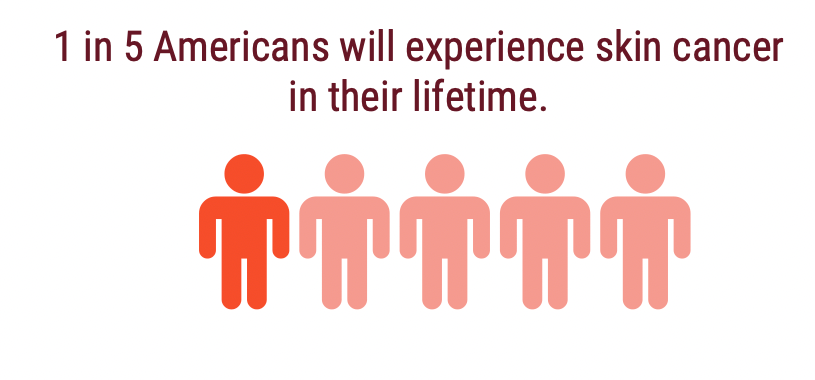
As per the American Academy of Dermatology approximately 1 in 5 Americans will develop skin cancer in their lifetime. More than 1 million Americans are living with skin cancer. There are two common types of skin cancer Melanoma and Non-Melanoma. Most common types of Non – Melanomas are Basal Cell Carcinoma and Squamous Cell Carcinoma. Skin cancers usually present as a rash / nodule or an ulcer that doesn’t heal that changes in size, shape and color.
WHO IS AT RISK OF DEVELOPING SKIN CANCER
Anyone can develop skin cancer. It mostly affects Older adults, however it can also occur in young adults. Although it can occur in any skin types, Light skin people are more at risk. In dark skin people it is often diagnosed later in stage and is often harder to treat. Before 50 years of age women are at high risk of developing skin cancer, however the risk of developing skin cancer for men increases to twice as high after age 65. People who have family history of skin cancer are at higher risk than the general population.
RISK FACTORS ASSOCIATED WITH SKIN CANCER
- Exposure to UV radiation (Natural sunlight and artificial UV radiation)
- Frequent sunburns
- Exposure to tanning beds
- Smoking
MORTALITY & SURVIVAL RATES
Basal Cell Carcinoma and Squamous Cell Carcinoma have good prognosis and have a very high chance of cure if detected and treated early. Localized melanoma without spreading to lymph nodes have a 5 year survival rate of 92% , however if it was diagnosed after spreading to lymph nodes the survival rate decreases to 25 – 65% depending on the stage. Recurrence rate of developing another skin cancer or recurring skin cancer is high.
PREVENTION
It is very important to seek medical help if you notice a rash, nodule, mole or ulcer that is not healing. Rate of cure and survival is increased if the cancer is diagnosed early and treated early. It is always better to practice preventive measures to decrease the risk of getting skin cancer.
- Avoid Tanning beds
- Apply Sunscreen
SELECTING & APPLYING SUNSCREEN
- Broad spectrum sunscreen is necessary to cover both Ultraviolet A and Ultraviolet B range
- Sun protection factor (SPF) of 30 or higher is needed especially for people who have increased sun exposure either by working or playing outside or relaxing in the sun.
- If you are playing sports or participating in water activities it is important to use water resistant sunscreen
- Sunscreen must be used in all body parts that is exposed to sun.
- Sunscreen must be applied at least 15- 30 minutes before the sun exposure and need to be reapplied at least every 2 hours and after every water exposure.
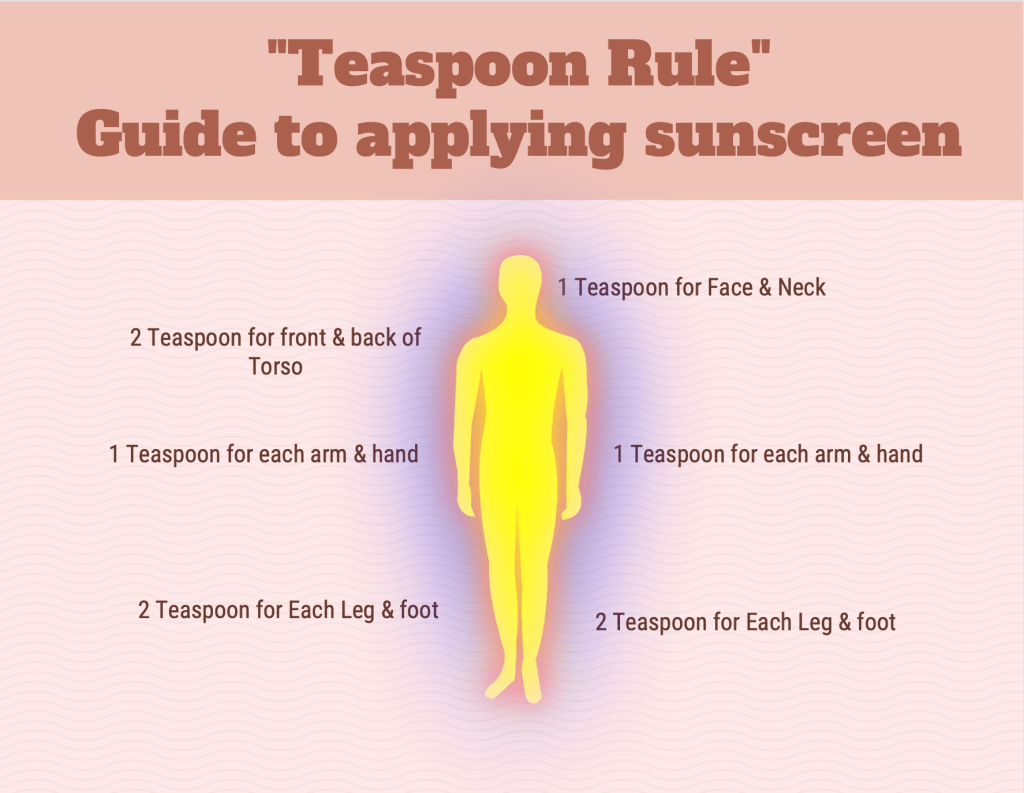
- You can use the ” Teaspoon rule ” to make sure you get adequate sunscreen in your body. Teaspoon rule is considered as using 1 teaspoon of sunscreen to face and neck area, 1 teaspoon of sunscreen to each upper extremity (arms & hands), 2 teaspoon of sunscreen for front and back of the torso and 2 teaspoon of sunscreen to each lower extremities (legs & feet).
 Mediculous