
Complications of Long term Proton Pump Inhibitors use

What are Proton Pump Inhibitors?

Proton Pump Inhibitors (PPI) are medications that are used to treat acid reflux and Gastric ulcers. They work by stopping/ reducing the acid production in the stomach. Although stomach acid is essential for digestion and absorption of food and nutrients, excess stomach acid can damage the stomach lining and cause Gastric ulcers, dyspepsia , acid reflux and Barrett’s esophagus (which can turn into esophageal cancer). Omeprazole (prilosec), Pantoprazole (Protonix) , esomeprazole (Nexium) are some of the PPIs that are widely used by people. 

Complications of long term use of PPI
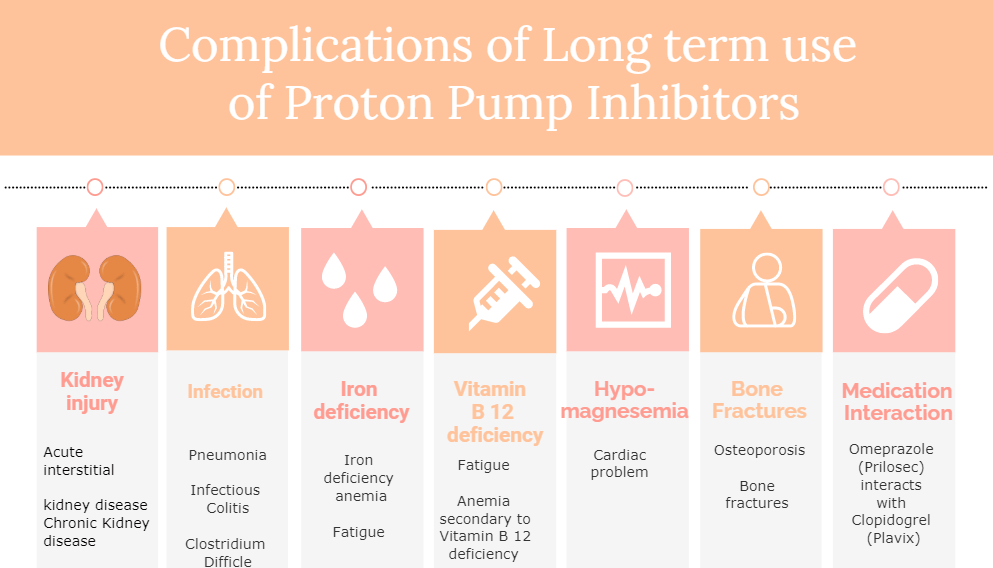
  • Acute interstitial nephritis or CKD
    • It is unclear how PPI use can cause CKD or interstial nephritis
  • Pneumonia
    • Long term PPI use alters the stomach acidity and thereby cause a disruption in stomach bacteria. This increases the risk of pneumonia.
  • Increased GI infection
    • Long term PPI use alters the stomach acidity and thereby cause a disruption in stomach bacteria. This can lead to Infectious colitis or Clostridium difficle infection.  
  • Iron Deficiency 
    • Stomach acid is necessary for absorption of certain minerals and vitamins. By inhibiting stomach acid the absorption of iron is impaired and thereby it causes iron deficiency anemia.
  • Vitamin B12 deficiency 
    • Stomach acid is necessary for absorption of certain minerals and vitamins. By inhibiting stomach acid the absorption of Vitamin B12 is impaired. This can lead to feeling fatigue / Tired and anemia secondary to vitamin B12 deficiency
  • Bone fracture
    • Stomach acid is necessary for absorption of certain minerals and vitamins. By inhibiting stomach acid the absorption of calcium is impaired. Calcium is necessary for bones. Calcium impairment can lead to osteoporosis (fragile bones) that can easily fracture.
  • Hypomagnesemia 
    • Stomach acid is necessary for absorption of certain minerals and vitamins. By inhibiting stomach acid the absorption of magnesium is impaired. Magnesium is essential for many important body functions including cardiac activity .
  • Medication interaction (omeprazole reduces the effectiveness of clopidogrel)
    • Clopidogrel is a medication that prevents blood vessels from clogging. This medication absorption is affected by omeprazole (a PPI). Other Proton Pump Inhibitors don’t affect the absorption of clopidogrel (Plavix).

If you’re on a PPI don’t discontinue without consulting with your doctor. All medications have some side effects, but discuss with your doctor to see if the benefits of medication outweighs the risks in your situation. Rapidly stopping the PPI can cause rebound acid reflux symptoms. If you’re taking a PPI for acid reflux , try to change your diet and control the symptoms with lifestyle modifications as much as possible to reduce the use of medications and to reduce the risk of side effects.
ACID REFLUX

Acid reflux is when the acid that is normally in your stomach backs up into the esophagus (tube that carries food from your mouth to your stomach). It is also known as Gastroesophageal Reflux disease or GERD.

sYMPTOMS OF ACID REFLUX

  • Burning sensation in the chest (heart burn) 
  • Cough 
  • Burning in the throat or an acid taste in the throat 
  • Stomach pain 
  • Trouble swallowing 
  • sore throat or hoarseness 
  • Recurrent lung infection 

Behavioral modifications TO MANAGE Acid Reflux

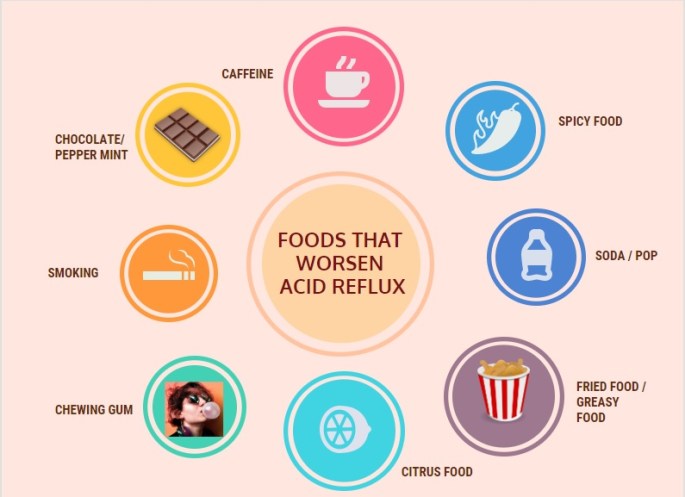
  • Avoid certain food and beverages such as caffeine, peppermint, spicy food, greasy food, chocolate, Soda, pepper, citrus food, chewing gum and alcohol   
  • Avoid smoking 
  • If you’re overweight, losing weight can help control acid reflux symptoms 
  • Avoid medications such as ibuprofen (also known as Motrin / Advil), Aspirin
  • Avoid going to bed soon after eating (avoid going to bed at least 3 hrs. after eating), when going to bed elevate the head of the bed by 6 to 8 inch  
  • Avoid tight fitting clothes  

MEDICAL MANAGEMENT OF ACID REFLUX

  • Over the counter antacids such as Tums can neutralize the stomach acid and provide relief 
  • For persistent symptoms your doctor can prescribe antihistamines such as Zantac or Pepcid or Proton pump inhibitor such as Prilosec / Nexium / Protonix 
  • Proton pump inhibitors are the most effective medications in the treatment of GERD, however they also contain a lot of adverse effects. When taken for a long time it can cause bone loss, it can increase certain infections.

What if symptoms persist despite medication and behavioral modifications? 

If the symptoms persist despite medications and behavioral modifications or if you experience unintentional weight loss, feeling of food getting stuck, vomiting blood or blood in stool your doctor will order Endoscopy to rule out more serious medical conditions.  

An upper endoscopy is commonly used to evaluate the esophagus. A small, flexible tube is passed into the esophagus, stomach, and small intestine. The tube has a light source and a camera that displays magnified images. Damage to the lining of these structures can be evaluated and a small sample of tissue (biopsy) can be taken to determine the extent of tissue damage. 

complications of long term uncontrolled GERD

  • Ulcer – Ulcers can form in the esophagus as a result of burning from stomach acid.  
  • Stricture –  Damage from acid can cause the esophagus to scar and narrow, causing a blockage (stricture) that can cause food or pills to get stuck in the esophagus. 
  • Barret’s Esophagus – During repeated exposure of stomach acid in the esophagus there is a risk of esophagus lining (squamous cells) to change into a different type of cell (intestinal cell). This change has a potential to develop into cancer cells 
  • Esophageal cancer