
Bile duct is a tube that starts in the liver and ends at the small intestine while connecting to the gallbladder. This tubes carries the bile which is used to break down fats in the food. Bile ducts are connected to hepatic ducts in the liver. By connecting to the hepatic ducts, bile duct also help get rid of the toxins that are metabolized by the liver.

Bile duct cancer
Cancer is caused by abnormal growth of cells. Cancer can occur at any part of the bile duct. Extrahepatic cholangiocarcinoma occurs in the bile duct that is outside the liver. This type of bile duct cancer has better prognosis than other biliary cancers. Hilar cholangiocarcinoma (Klatskin tumor) occurs where the left and right hepatic ducts join to form the common bile duct. Intrahepatic cholangiocarcinoma occurs inside the liver.
Risk factors for Cholangiocarcinoma
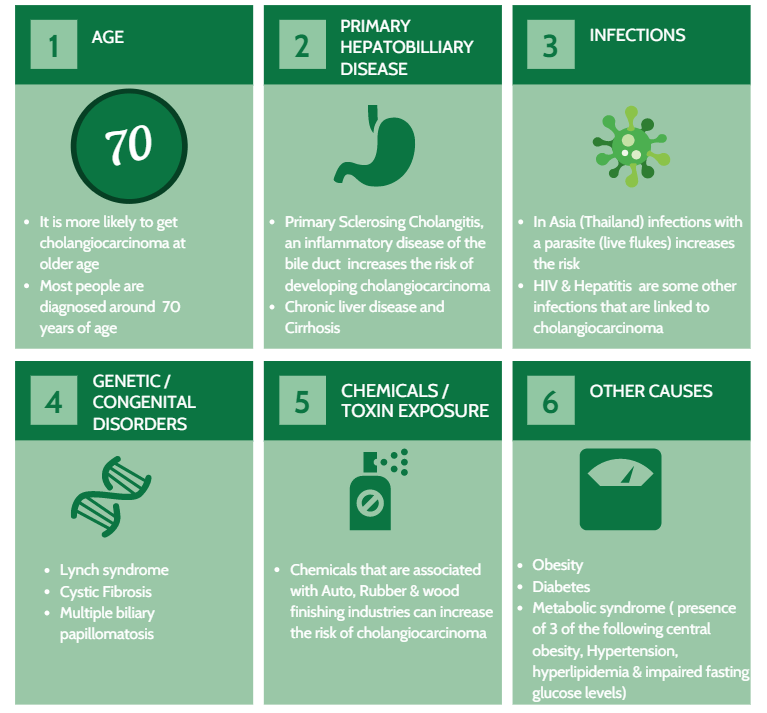
Epidemiology and statistics of cholangiocarcinoma
Primary cholangiocarcinoma is diagnosed at the 7th decade of life (approximately around 70 years of age). Although it is not as common as the breast , colon or prostate cancer, In the USA , approximately 8000 people are diagnosed with this type of cancer every year. The incidence is highest among Hispanics and Asians. Men has slightly higher risk of getting cholangiocarcinoma than women.
Extrahepatic cholangiocarcinoma has the best prognosis with an approximate 5 year survival rate of 10% (which means that the patients with this type of cancer have a 10% chance of living like a person without the cancer ). If the cancer has spread or metastasized to other parts the 5 year survival rate decreases to 2%.
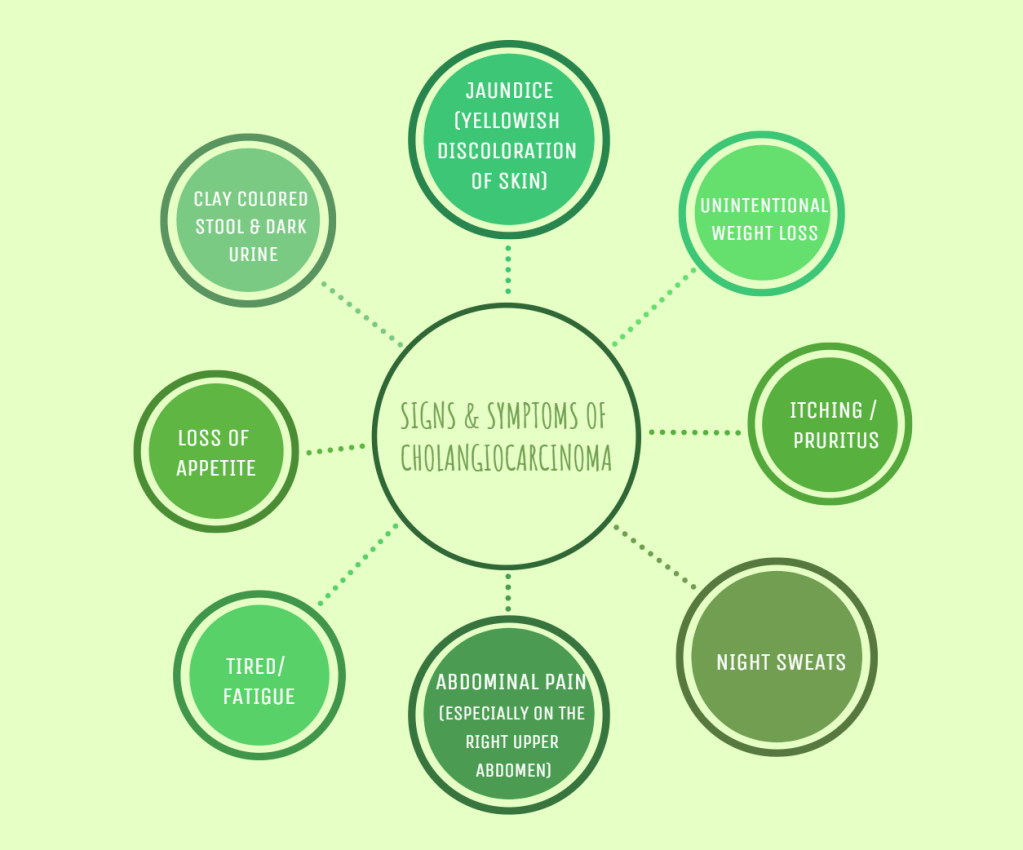
Signs & symptoms
Symptoms associated with bile duct cancer are usually due to the cancer blocking the bile duct drainage. Most of the time Signs and symptoms do not appear until the cancer is advanced or big enough to cause a blockage. Early signs and symptoms are nonspecific and usually most people miss to notice it. If you experience any symptoms mentioned below, let your doctor know no matter how small the symptom is.
How is Cholangiocarcinoma diagnosed?
Cholangiocarcinoma is diagnosed using a combination of blood test , imaging and biopsy. Blood test that shows liver function can be abnormally elevated due to the cancer blocking the biliary drainage. Tumor markers such as CEA, and CA 19- 9 can also be elevated on blood test. However these are not common blood test that your doctor orders at general annual checkup. If you notice any signs and symptoms mentioned above, make sure you discuss with your doctor even if its something small.
Imaging test such as Ultrasound of the abdomen, CT scan of the abdomen and MRCP (MRI of the bile duct and pancreas) can help notice the tumor, the location, size and spreading to other locations.
Biopsy of the tumor is essential to confirm the diagnosis of cholangiocarcinoma. Biopsy can be performed by Endoscopic Retrograde CholangioPancreatography (ERCP) or percutaneous transhepatic cholangiography (PTC). ERCP is performed under general anesthesia where you are put to sleep. Your surgeon will then put a tube with a camera down your food pipe (esophagus) then to the stomach and duodenum. Through the camera surgeon will be able to see the tumor and will be able to take samples / biopsy of the tumor to examine under the microscope.
percutaneous transhepatic cholangiography (PTC) is performed by interventional radiologist. A needle is inserted into the liver and then into the bile duct using a series of imaging to guide the needle. once the needle is inserted into the bile duct a dye is inserted and more imaging will be taken to better see the tumor. a sample or biopsy can also be obtained to better analyze the tumor.
Both of these procedures can also relieve the biliary blockage caused by the tumor temporarily. With ERCP your surgeon can place a stent (a tiny tube made with plastic or metal) to keep the biliary duct open. With PTC your interventional radiologist can place a tube into the biliary duct that can drain the biliary fluid externally into a bag outside.
Treatment & Prognosis
Unfortunately there are no preventive screenings available for cholangiocarcinoma to prevent them or to catch them early and treat them. Some cholangiocarcinoma can be resected / surgically removed. Surgery may also sometimes involve fully or partially removing the bile duct and liver. However not all cholangiocarcinomas can be surgically resected. If it’s an unresectable cancer Chemotherapy and radiation therapy is an option depending on the type and stage of the cancer.
Other treatment includes stent placement , PTC drainage for symptom relief. Palliative or Hospice care if the cancer is advanced and the treatment is more harmful than being beneficial.
Questions to ask your Oncologist if you or your loved ones are diagnosed with Cholangiocarcinoma
It is difficult to hear a diagnosis of Cancer. It is normal to have a lot of questions and concerns. It is important to ask all your questions and have clear understanding about what is going on before making decisions regarding the procedures or treatment options. Don’t hesitate to repeat the questions if you are still unsure. I have listed few questions that could help better understand the disease, procedures, treatment options and Prognosis.
- What is the type of cholangiocarcinoma?
- What is the stage of the Cancer ? Is it localized to the bile duct or did it spread to other areas of the body ?
- What did the biopsy results show?
- what is my prognosis?
- Is the cancer surgically removable? if so can it be removed completely? will you also have to remove other organs such as liver or lymph nodes ?
- What are the complications from surgery? How will my life change after the surgery ?
- What is the chance that the cancer can be completely cured? what is the rate of the cancer recurring again?
- If the cancer can be completely removed will i still have to go through chemo or radiation?
- If it’s not removable what other options do i have?
- what is the 1 year and 5 year survival rate without any treatment?
- What is the 1 year and 5 year survival rate with chemo or radiation?
- How do i interpret the 1 year and 5 year survival rate?
- Is my body strong enough to handle Surgery. Chemo or radiation?
- Will the complications from surgery , Chemo or Radiation be more harmful than the cancer itself?
- Can this cancer be completely cured or is the treatment just giving me more time? If so how much more time will i be getting with the treatment compared to without treatment?
- Are there any clinical trials available that would suit me?
- If i chose not to get any treatment how will you help me live a quality of life as long as i live?
- What is the difference between full treatment, Palliative care and Hospice?
- If i choose to not get treatment for cancer can you still control my symptoms (pain, nausea, weakness etc)?
 Mediculous